Peak District Trails vs. Yorkshire Dales Trails: Which Should You Choose?
Two national parks, roughly an hour apart depending on where you start and how kind the A623 is being. Both are stone-walled, sheep-creased, rain-prone uplands with pubs that serve decent chips. Yet walkers who adore one often find the other slightly off-key — and it usually comes down to rock, scale and how far you have to drive for a sandwich.
Here is how the two actually differ, and how to choose between them for the trip you're planning.
The rock under your boots
The Peak District is really two parks stitched together. The Dark Peak in the north is gritstone country: Kinder Scout, Bleaklow, Stanage Edge, Derwent Edge. Expect black peat, cloughs cut into the plateau, and long horizontal edges that catch the light at either end of the day. The White Peak in the south is limestone: Dovedale, Lathkill Dale, Cave Dale. Here you get clearer streams, wooded ravines, and footpaths that behave themselves.
The Yorkshire Dales are mostly limestone too, but on a grander and more dramatic scale. Malham Cove is a curved amphitheatre of rock with a limestone pavement above it. Dry valleys, shake holes, caves and potholes thread through the whole park. Above the limestone, the three famous fells — Ingleborough, Whernside and Pen-y-ghent — are capped with gritstone and shale, which is why they look like proper mountains rather than hills.
What you'll actually be looking at
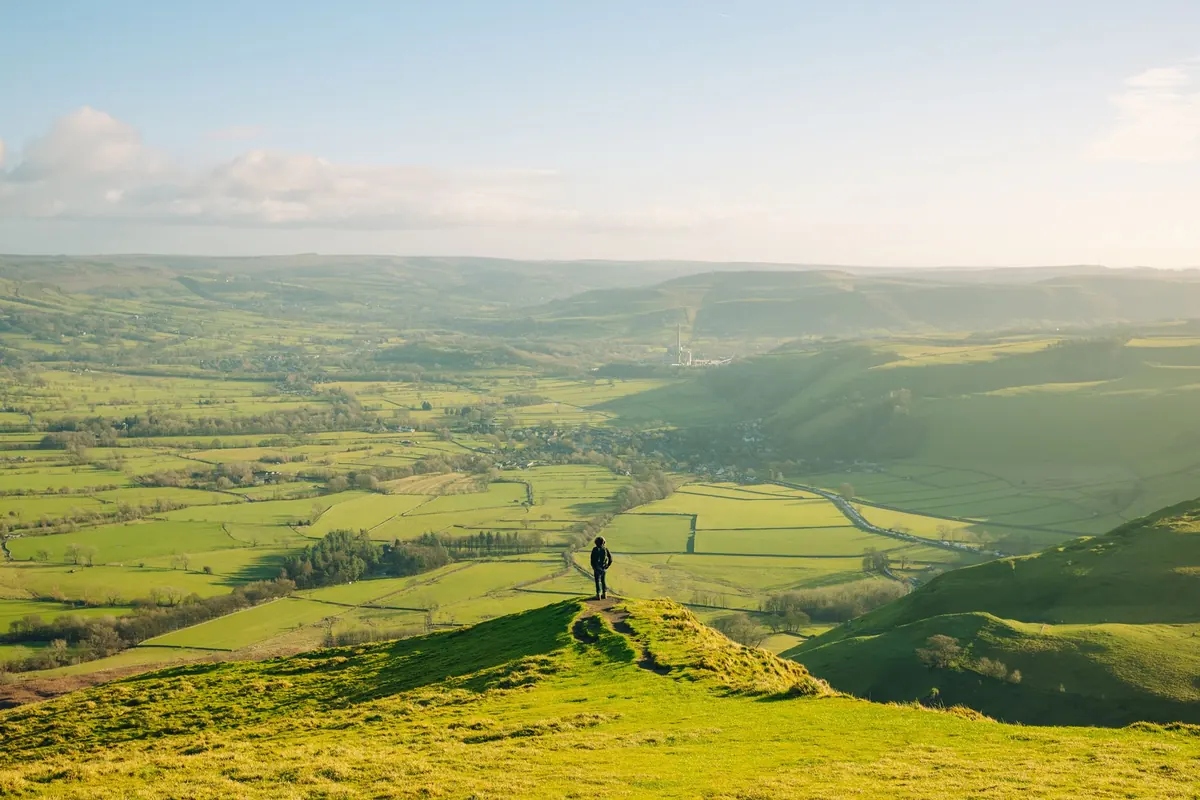
Peak District scenery is about edges and enclosure. Stand on Stanage or Curbar and you get a long sweep west over Hathersage and the Hope Valley, with reservoirs and the occasional quarry in the middle distance. The park sits between Manchester, Sheffield, Derby and Stoke, and you can feel that: it is countryside with a lot of people in it.
The Dales feel emptier. Valleys are wider, walls run higher, and between Grassington and Hawes you can walk for hours seeing little more than sheep and a distant farm. In late spring the hay meadows around Muker and Keld fill with wildflowers, and Swaledale and Wharfedale give you the classic combination of river, fell and stone barn. If you want the sensation of being a long way from anything, the Dales win.
Difficulty: an honest comparison
The gentle end is well covered in both parks. In the Peak you have the Monsal Trail and the Tissington Trail, both former railway lines, flat and firm and good for families, bikes and pushchairs. Dovedale from Ilam is a short, pretty riverside stroll. In the Dales, the low-level options are equally good: Malham to Janet's Foss and Gordale Scar, the riverside path at Bolton Abbey, or the walk to Aysgarth Falls.
It moves apart in the middle. A Peak day such as the Great Ridge from Mam Tor involves short, sharp pulls but plenty of escape routes and a village at either end. A Dales day such as the Malham circular or Ingleborough from Clapham generally involves more sustained climbing and longer stretches with no easy way off.
The hard end is where the Dales bite harder. The Yorkshire Three Peaks round is roughly 24 miles with about 1,500 metres of ascent, and it is a serious day out for fit, well-prepared walkers. The Peak has nothing quite like it in a single route, though a Kinder Scout traverse via Grindsbrook and the plateau edge, or a big Bleaklow crossing, will test navigation and stamina just as much. Peat on Kinder and Bleaklow can be genuinely confusing in cloud, and so can the Dales fells in mist. Carry a paper map and compass in both parks — phone batteries die and signal vanishes.
Villages, transport and facilities
This is the biggest practical difference. The Peak District is a patchwork of towns and villages with trains, buses, cafés, gear shops and pubs: Edale, Hope, Hathersage, Castleton, Bakewell, Buxton. The Hope Valley line alone puts you within walking distance of several excellent routes, and you can plan a day using train and bus without touching a car.
The Dales are sparser. Settle, Horton-in-Ribblesdale, Ribblehead and Dent sit on the Settle–Carlisle line, which is useful for the Three Peaks, and Grassington, Malham, Kettlewell, Hawes and Reeth all have somewhere to eat. But buses are infrequent, Sunday services are thin, and the last one back is often earlier than you'd like. Most Dales trips are car-based, and car parks at Malham, Horton and Ribblehead fill quickly in summer.
Choose the Peak District if…
- You're coming from Manchester, Sheffield, Derby, Nottingham or Stoke and want under an hour of travel.
- You need public transport, a café mid-route and a pub at the end.
- You're walking with children, less confident walkers, or a mixed-ability group.
- You want gritstone edges, wooded limestone dales and variety within a short drive.
Choose the Yorkshire Dales if…
- You want big fell days and long, quiet valley walks.
- You're happy to drive between trailheads and carry everything you need.
- You like limestone scenery, waterfalls and cave country.
- You want a sense of remoteness without going to Scotland.
Weather and crowds
Both parks are wet, and both can turn in twenty minutes. The White Peak's dales offer some shelter; the Dark Peak plateau and the Dales fells do not, so pack a waterproof regardless of the forecast and treat wind on the tops as the deciding factor in winter. Snow and ice on Kinder, Ingleborough and Whernside are common from late autumn into early spring.
Expect crowds in both. The Peak is one of the most visited national parks in the country, and honeypots like Dovedale, Mam Tor and Stanage get busy by mid-morning. The Dales are quieter overall, though Malham, Ribblehead and the Three Peaks path can feel like a procession in summer. Start early and you'll have the best of either.
One health note: long grass and bracken mean ticks, so check yourself after a day out, and if you feel unwell in the weeks afterwards, speak to a doctor.
How to decide
- Count your travel time honestly. If either park is more than 90 minutes away each way, the Peak's shorter low-level options will probably give you a better day.
- Match distance to daylight. In winter, keep Dales fell days to single figures in miles and save the long rounds for June and July.
- Decide what you need at the end. A hot meal and a bus stop points to the Peak. A quiet drive home and an empty horizon points to the Dales.
- Be honest about navigation. If you're not confident with a map and compass in poor visibility, start in the White Peak or the Dales' valley paths and build up.
- Do both anyway. Base yourself in Edale or Hathersage for one weekend, then Grassington or Malham for another. They complement each other better than they compete.
Check the mountain weather forecast the night before, tell someone your route and expected return time, and take more water than feels necessary. Whichever park you pick, that's the difference between a good day and a memorable one.
Photo: Simon Migaj / Pexels
You Might Also Like
From Edale's Pennine Way start to Bakewell's gentle dales, here is how to choose a Peak District base that puts the walks you want on your doorstep.
Camping, hostels and B&Bs each ask something different of your budget, your legs and your planning. A practical comparison for Pennine Way walkers choosing where to sleep.